

The History of Tae Kwon-Do
Tae Kwon-Do is a version of an ancient form of unarmed combat practised for many centuries in the Orient. Tae Kwon-Do became perfected in its present form in Korea.
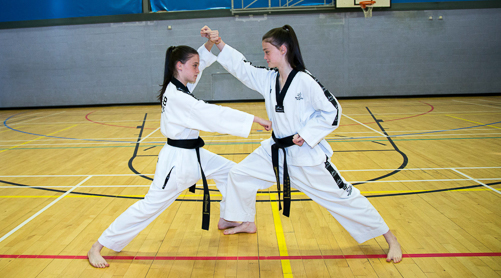
Translated from Korean, ‘Tae’ literally means to jump, kick or smash with the foot. ‘Kwon’ means a fist chiefly to punch or destroy with the hand or fist. ‘Do’ means art, way or method. Tae Kwon Do indicates the technique of unarmed combat for self-defence, involving the skilled application of punches, kicks, blocks, dodges and interception with the hand, arms and feet to the rapid destruction of the opponent.
To the Korean people Tae Kwon Do is more than a mere use of skilled movements. It also implies a way of thinking and life, particularly in instilling a concept and spirit of strict self-imposed discipline and an ideal of noble moral re-armament.
In these days of violence and intimidation, which seem to plague our modern societies, Tae Kwon Do enables the weak to possess a fine weapon to defend himself or herself and defeat the opponent as well. When wrongly applied it can be a lethal weapon.
TENETS OF TAE KWON-DO
COURTESY – To be polite to one’s instructors, seniors and fellow students
INTEGRITY – To be honest with oneself. One must be able to define right and wrong
PERSEVERANCE – To achieve a goal, whether it is a higher grade or any technique, one must not stop trying; one must persevere
SELF CONTROL – To lose one’s temper when performing techniques against an opponent can be very dangerous and shows lack of control. To be able to live, work and train within one’s capability shows good self control
INDOMITABLE SPIRIT – To show courage when you and your principles are pitted against overwhelming odds

The Mark Of A Good Student
Student Oath
“As a student of Tae Kwon Do, I do solemnly pledge to abide by the rules and regulations of the Tae Kwon Do Association, to strive always to be modest, courteous and respectful to all members, in particular my seniors, to put the art into use only for self defence or defence of the weak and never to abuse my knowledge of the art.”
Conduct in the Dojang
Every student must observe the following conduct in the Dojang in order to maintain an orderly and effective training hall:
Bow upon entering
Bow to the Instructor at a proper distance
Exchange greetings between students
Bow to Instructor upon forming a line prior to training
Bow to the Instructor upon forming a line prior to dismissal
Bow before leaving the Dojang.
10 ways to become a good student
Never tire of learning; a student must always be eager to learn and ask questions. A good student can learn anywhere anytime. This is the secret of knowledge
A good student must be willing to sacrifice for his art and his Instructor. Many students feel that their training is a commodity bought with monthly fees, and are unwilling to take part in any demonstrations, teaching, or work around the Dojang. An instructor can afford to lose this type of student
Always set a good example to lower ranking students. It is only natural that they attempt to emulate their seniors
Always be loyal and never criticise the Instructor, Tae Kwon Do, or the teaching methods
If an Instructor teaches a technique, practise it and attempt to utilise it
Remember that a student’s conduct outside the Dojang reflects on the Art and on their Instructor
If a student adopts a technique from another Dojang and the Instructor disapproves of it, the student must discard it immediately, or train in the Dojang where it was learnt
Never be disrespectful to the Instructor, although a student’ s allowed to disagree with the Instructor, he must first follow the Instruction, then discuss the matter later
Always arrive before training is due to start, and ensure that you have a good attendance record
Never break a trust.
RULES & REGULATIONS
All students must complete and sign the relevant application forms prior to commencing training
All students must be in possession of a T.A.G.B. membership and record card after their first four weeks training
Subscriptions to be paid in the first week of every month. Failure to do so will incur a penalty fee
The build up of arrears is not accepted
One month’s prior notice must be given for adjustment of fees owing to holidays etc.
Any student not attending lessons and not paying fees for a continuous period of 2 months or more, shall pay a re enrolment fee before being allowed to re commence training
No smoking, eating, drinking or wearing of jewellery, rings etc. in the dojang is permitted
- Whilst wearing a dobok NO SMOKING is permitted regardless of the place. (dojang, tournament, demonstration etc.)
When eating or drinking whilst wearing a dobok your belt must be removed
After the first grading a dobok must be worn during training in the dojang, wearing tracksuits or outside clothes is not permitted, unless prior permission has been obtained from the Instructor
The most senior member present will commence training sessions promptly until the Instructor arrives
Misuse of the Art will result in disciplinary action
Grading will depend on attendance and the Instructors discretion as well as technical ability
No student may officially change schools without completing a transfer form and obtaining prior permission from both Instructors concerned
All students should be in possession of a Students Handbook after their first grading.
Yes, providing you are a member of the TAGB and hold a current TAGB license. Licenses are renewable every year.
No. Training in TKD has a highly structured syllabus. Through a program of staged grading’s (each denoted by the colour of the belt) the student is allowed to develop at a steady pace. This is what makes TKD so popular and available to all ages.
Yes. The more the merrier. Sometimes training with a friend can be an incentive to push yourself harder. Introduce a friend and if they join you will receive a £20 voucher towards TAGB equipment.
Training is up to you and depending upon your type of membership you can train as many times as you like. We recommend that members train a minimum of twice a week.





GET IN TOUCH TODAY
Ready to make a life change? We’re thrilled to help you along your path to a fit and healthy life. Our experts take great pride in helping achieve your goals.